Cosori TurboBlaze 6 Qt Air Fryer Review: Worth It? (October 2026)
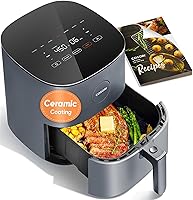
The Cosori TurboBlaze suits buyers who want a roomy single basket with PFAS-free ceramic-coated cooking parts. Choose it for flexible cooking temperatures and everyday batches; choose a smaller fryer for modest portions or separate cooking zones for foods that need different settings.
On this page (8 sections)
- What stands out about the Cosori TurboBlaze?
- Is 6 qt the right size for your kitchen?
- What do the coating and cleanup features mean?
- Which alternatives make more sense?
- How should you set up and start using it?
- Which common mistakes affect air-fried food?
- Does the TurboBlaze replace a toaster oven?
- Should you buy the Cosori TurboBlaze or an alternative?
The Cosori TurboBlaze is a good choice for roomy single-basket cooking with ceramic-coated parts, especially if you'll use roasting, drying or proofing alongside air frying. Its main limitation is meal timing: everything in the basket shares the same cooking setting.
Choose it for one generous batch of vegetables, chicken pieces or frozen snacks. If your usual dinner needs two temperatures at once, compare dual-basket air fryers before settling on a single basket.
What stands out about the Cosori TurboBlaze?
The TurboBlaze combines flexible heat settings and a square cooking basket rather than relying only on preset food buttons. That makes it a better fit for cooks who want to adjust recipes than for buyers who only need to reheat an occasional snack.
Cosori TurboBlaze 6 Qt: Best for varied meal prep

- 6 qt square basket
- PFAS-free ceramic coating
- Five fan speeds
- 90°F–450°F temperature range
A roomy single-basket choice for cooks who want to air fry, roast, dry or proof in the same appliance. Ceramic-coated cooking parts and optional preheating give it useful flexibility beyond frozen snacks.
Pros
- PFAS-free ceramic-coated basket and crisper plate
- Five fan speeds
- Low-temperature Dry and Proof modes
- Dishwasher-safe cooking parts
Cons
- One cooking zone for the whole meal
- Needs ventilation space behind and above
- Larger basket may be unnecessary for small portions
Its 6 qt basket has about 9.31 in by 9.31 in of usable floor space, with 3.48 in of height above the crisper plate. Those measurements are more useful than capacity alone when judging whether your usual food or a suitable baking dish will fit.
The temperature range runs from 90°F to 450°F, supported by a five-speed fan system. Named modes include Air Fry, Roast, Broil, Frozen, Bake, Dry and Proof, plus a customizable preheat function.
The lower end matters if you want to dry food or proof dough, while the upper end gives you room for high-heat browning. A hotter setting isn't automatically better: thick foods can brown outside before the middle is ready.
Cosori says operating noise stays below 53 dB even at the highest fan speed. Consider that if kitchen noise matters to you, but don't expect a fan-driven appliance to be silent.
Who should choose the Cosori TurboBlaze?
Choose the TurboBlaze if one shared cooking zone fits your meals and you want room to spread food out. It's especially useful when you cook a main dish in the basket while preparing rice, pasta or another side elsewhere.
Skip it if you expect the basket to cook a whole mixed dinner without managing different finishing times. Chicken pieces and thin vegetables may need separate starts, separate batches or another appliance.
It also makes less sense if you only want small servings and won't use its extra cooking modes. Buy around the meals you repeat each week, rather than the longest feature list.
Is 6 qt the right size for your kitchen?
The basket is a sensible middle choice between the smaller alternatives here and the larger Chefman, but food shape determines batch size. A deep pile of fries uses volume differently from fish fillets that need room across the basket floor.
Picture your normal meal laid out without heavy overlap. If it needs a second batch, decide whether that extra time fits your routine before choosing a fryer.
The TurboBlaze measures about 14.4 in deep, 11.8 in wide and 11.9 in high. Cosori calls for 5 in of clearance behind and above it, plus enough room to open the basket.
Measure the working position, not just the storage spot. A fryer that fits beneath a cabinet when unplugged may need to move forward before use to provide ventilation.
Allow a clear path for pulling the basket out and a heat-safe place to rest it. Don't plan to carry a hot basket across a crowded kitchen each time you need to shake or serve food.
For more help matching portions to basket space, read our guide to choosing an air fryer size. If you routinely cook for several people, compare large air fryers for families.
What do the coating and cleanup features mean?
The basket and crisper plate have PFAS-free nonstick ceramic coating, and both removable cooking parts are dishwasher-safe. Choose this model if those specific cooking-surface and cleanup features matter to you.
Ceramic coating still needs gentle care. Use utensils suitable for nonstick surfaces, and avoid cutting food inside the basket or scraping stuck pieces with metal tools.
For cooking-surface trade-offs, our guide to glass, ceramic and stainless air fryers explains the choices. A coating description isn't a reason to expect better nutrition from every meal.
Let the basket cool before washing, then remove loose crumbs and grease. Soften stuck residue with warm, soapy water rather than scrubbing harder.
Clean around and beneath the crisper plate, where drips can collect. Dry the removable parts before putting them back, and follow the manual's separate directions for wiping the powered main unit.
Dishwasher-safe doesn't mean every part belongs in the dishwasher. Our guide to air fryer basket dishwasher care covers the care habits that help protect removable cooking parts.
Which alternatives make more sense?
Choose the Ninja for core cooking tasks, Chefman for bigger batches or Pro LE for a narrower Cosori. Each alternative solves a different daily need, so start with your main reason for considering something other than the TurboBlaze.
Ninja AF141: for reheating and simple meals
Ninja Air Fryer Pro AF141: Best for everyday reheating

- 5 qt basket
- Air Fry, Roast, Reheat and Dehydrate
- 1750 watts
- 400°F maximum
A straightforward alternative for frozen snacks, roasted sides and reheated leftovers. Its narrower body helps where counter width is limited, but check depth before choosing it.
Pros
- Four clearly named cooking functions
- Narrower body than the TurboBlaze
- Nonstick basket and removable crisper plate
Cons
- Less basket capacity than the TurboBlaze
- Lower maximum temperature
- Slightly deeper body than the TurboBlaze
The Ninja Air Fryer Pro AF141 suits cooks who mainly want Air Fry, Roast, Reheat and Dehydrate. Its 5 qt basket and 400°F maximum cover those core tasks without making additional modes the reason to buy.
Choose it for leftovers, frozen snacks and side dishes when a smaller basket fits your normal portions. A dedicated Reheat function gives you a clear starting point, though food thickness and portion size still call for adjustments.
Its body is 11.29 in wide and 14.84 in deep. That saves some width beside another appliance, but it needs slightly more front-to-back space than the TurboBlaze.
Skip the Ninja if extra batch room or the Cosori's lower-temperature modes are central to your plans. Its narrower body is useful only if the full appliance and required ventilation fit your counter.
Chefman TurboFry: for larger shared batches
Chefman TurboFry 9 Qt: Best for bigger households

- 9 qt basket
- Seven cooking functions
- Viewing window
- 450°F maximum
The larger-batch choice for households that regularly fill a basket with the same food. A viewing window, shake reminder and Keep Warm function help with managing meals.
Pros
- Largest basket capacity in this group
- Viewing window and shake reminder
- Customizable Keep Warm function
- Basket and rack are top-rack dishwasher-safe
Cons
- Deepest appliance in this group
- Single basket cannot provide separate cooking temperatures
- Oversized for frequent small portions
The Chefman TurboFry suits households that regularly fill a basket with the same food. Its 9 qt capacity is the largest here, and the viewing window lets you watch browning without pulling the basket out.
It reaches 450°F and includes a Frozen function that begins at a lower temperature before crisping. A shake reminder helps prompt food movement, while the customizable Keep Warm function can hold food for up to 30 minutes.
Choose it when batch size is your main concern and you have room for its 15.75 in depth. The basket and rack are top-rack dishwasher-safe, so consider dishwasher space as well as counter space.
Skip it for frequent small portions or meals that need two independent temperatures. More capacity doesn't create a second cooking zone, and holding crisp food can soften its texture.
Cosori Pro LE: for smaller portions and limited width
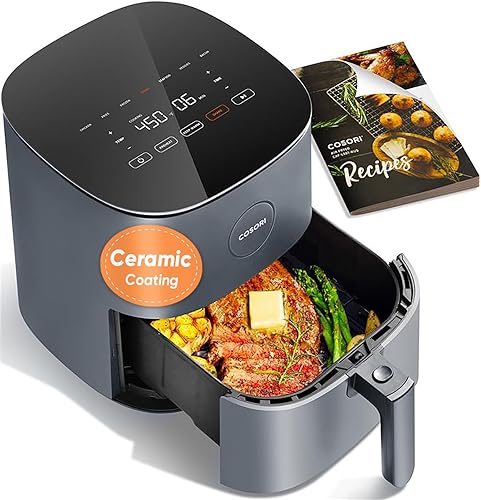
Cosori Air Fryer Pro LE 5 Qt: Best for smaller kitchens
- 5 qt square basket
- Ceramic coating
- 450°F maximum
- Seven presets
A narrower Cosori for cooks whose usual portions fit a smaller basket. It keeps ceramic-coated cooking parts and high-heat air frying, with presets, preheat and keep warm.
Pros
- Ceramic-coated basket and crisper tray
- Narrowest body in this group
- Seven presets plus preheat and keep warm
- Dishwasher-safe cooking parts
Cons
- Less cooking space than the TurboBlaze
- Needs overhead ventilation space
- Smaller basket can mean extra batches
The Cosori Air Fryer Pro LE suits buyers who want ceramic-coated cooking parts in a narrower body. Its 5 qt square basket makes sense when your usual meal doesn't need the TurboBlaze's extra space.
It reaches 450°F and offers seven presets, plus preheat and keep warm. Choose it if those familiar cooking tasks cover your needs and low-temperature proofing isn't a priority.
At about 10.8 in wide, it's the narrowest option here, but its roughly 12.1 in height still needs overhead clearance. Measure the space where it will run, including ventilation and basket access.
Skip it if you regularly spread larger portions across the basket floor. A smaller appliance loses its appeal if nearly every dinner needs an extra round of cooking.
For more brand detail, see Cosori TurboBlaze vs Ninja Air Fryer Pro. Our Cosori air fryer guide and Ninja air fryer guide cover other models.
How should you set up and start using it?
Start with a clear, heat-resistant counter and the manual's first-use steps. Remove packaging from the cooking area, clean the removable parts as directed and check the box for the envelope containing the manual and recipe book.
Keep the ventilation space open and follow the electrical instructions. Don't assume a convenient extension cord or crowded power strip is suitable for a heating appliance.
For your first meal, choose a familiar food and a modest batch. That makes it easier to learn how quickly the surface browns and how much food needs moving during cooking.
Use the cooking charts as starting points, then check food before the suggested finish. Keep a short note of the portion, setting and time that worked so your next batch is easier to repeat.
When should you use preheat?
Use preheat when your recipe calls for a hot start, especially when early surface browning matters. The TurboBlaze lets you enable preheating or leave it off, with preheat time adjusted to the chosen temperature.
Keep your approach consistent when repeating a recipe. Starting one batch in a cold basket and the next in a hot basket can change the cooking time.
Put food in carefully after preheating because the basket and plate will be hot. Use a food thermometer for meat and poultry; a browned crust doesn't show whether the center is ready.
Which common mistakes affect air-fried food?
Crowding the basket is the first habit to fix when food browns unevenly or stays soft. Hot air needs paths around the food, so a smaller batch can be more useful than a longer cooking time.
- Stacking food that needs a crisp surface: Spread pieces out and split the batch when necessary.
- Skipping movement: Shake loose foods or turn larger pieces when the recipe calls for it.
- Using maximum heat for everything: Lower the heat if the outside darkens before the center cooks.
- Adding too much oil: Use a light coating where the recipe calls for oil, rather than leaving pools beneath the food.
- Relying only on a preset: Check progress and adjust for food size, starting temperature and batch amount.
Be careful with loose paper liners, especially during preheating. Follow the appliance and liner instructions, and never let lightweight material lift toward the heating element.
A liner also shouldn't become a reason to skip cleaning beneath the crisper plate. Our guide to air fryer liners explains when they help and when they can restrict airflow.
Does the TurboBlaze replace a toaster oven?
It can handle some small-batch baking, roasting and broiling, but the basket shape limits what fits. Choose it for portions that benefit from moving hot air rather than assuming each oven recipe transfers unchanged.
Check any cookware against the usable basket measurements and the manual's guidance. A dish that fits tightly against the sides can leave too little room for air to circulate.
Keep a larger oven for broad trays, several dishes or baked foods that need a particular pan shape. The air fryer is most useful when its smaller cooking area matches the job.
See air fryer vs convection oven for how these formats differ and which cooking tasks suit each.
Should you buy the Cosori TurboBlaze or an alternative?
Buy the Cosori TurboBlaze if your usual batch fits its basket and you'll use its cooking flexibility. Before ordering, confirm the working clearance and think through how your main dish and side will finish together.
Pick the Ninja AF141 when the core cooking functions and narrower body fit your routine. Choose the Chefman TurboFry for larger shared batches, or the Cosori Pro LE when smaller portions and limited counter width matter most.
If every dinner needs two foods at different settings, make separate cooking zones your priority. If one basket matches your meals, the TurboBlaze is the strongest fit here for cooks who want to do more than basic air frying.
For other Cosori options, use the Cosori air fryer guide. To compare across brands, browse our Ninja and Cosori category.
Frequently asked questions
Is the Cosori TurboBlaze 6 Qt worth considering?
Yes, if you want a roomy single basket, ceramic-coated cooking parts and modes beyond basic air frying. Its low-temperature options suit cooks who will also dry or proof food, while the adjustable preheat function adds flexibility.
Skip it if you need independent cooking zones or usually make very small portions.
What can the Cosori TurboBlaze cook?
The TurboBlaze can air fry, roast, broil, cook frozen food, bake, dry and proof. That covers foods such as vegetables, frozen snacks and basket-sized baked dishes.
Match the mode to the recipe, leave room for airflow and check safe internal temperatures rather than judging meat only by its browned surface.
Is the Cosori TurboBlaze basket dishwasher-safe?
Yes, the ceramic-coated basket and crisper plate are dishwasher-safe. Follow the manual for loading and detergent guidance, and let the parts cool before cleaning.
For hand-washing, use a soft sponge and avoid abrasive tools; keep the powered main unit out of the sink and dishwasher.
How does the Cosori TurboBlaze compare with the Ninja AF141?
The TurboBlaze offers a larger 6 qt basket, ceramic coating and a higher maximum temperature than the 5 qt Ninja AF141. Choose the Cosori for broader cooking options and more batch space.
Choose the Ninja for its four core functions when smaller portions and a narrower body fit your routine.