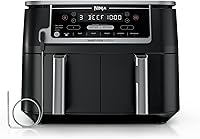
Dual Basket Air Fryer Buying Guide
Choose a dual basket air fryer for regular main-and-side meals that need different cooking settings. Buy for the space in each zone, and choose a removable divider if you also need one large cooking area.
On this page (12 sections)
- When is a dual basket air fryer useful?
- What are the trade-offs of two baskets?
- Should you choose separate baskets or a removable divider?
- Do sync and match controls matter?
- Which dual basket air fryer fits your cooking style?
- How can you tell what capacity you need?
- What should you measure before buying?
- How should you set up the first meal?
- What common mistakes make two-zone cooking harder?
- Is a dual basket air fryer harder to clean?
- How do two baskets affect cooking time?
- Which dual basket air fryer should you choose?
A dual basket air fryer is worth choosing when you regularly cook a main and side at different settings. Start with the portions that must fit in each zone, then check whether the appliance earns its counter space.
The biggest buying mistake is treating combined capacity as one large cooking area. Two smaller baskets can handle separate foods well but still leave too little room for a wide piece of food.
For a broad comparison of layouts, start with our large and dual basket air fryers guide. If you've settled on two zones, our best dual basket air fryers compares specific picks.
When is a dual basket air fryer useful?
A dual basket air fryer is most useful for meals with two foods that need different times or temperatures. It gives each food its own cooking area and controls.
Chicken pieces and vegetables are one example. You can choose settings for each food without trying to make one temperature suit both.
Separate zones also help when people want different portions or ingredients. They let you remove one food without tipping another onto the plate, though separate baskets don't establish protection from allergens.
Think about 3 dinners you make often. If each would use both zones, the layout has a clear role in your kitchen.
If you mainly reheat one lunch or make one batch of fries, a single basket is easier to justify. Two zones offer little benefit when the second one usually stays empty.
What are the trade-offs of two baskets?
The main trade-offs are split cooking space, a larger appliance footprint and more parts to wash. Decide whether easier meal timing is worth those costs in your daily routine.
A large total volume doesn't promise room for a wide fillet, a baking dish or a whole meal spread in one layer. Basket shape matters as much as the capacity number.
Two foods also need separate attention. One basket may need a shake while the other needs turning, so coordinated timers don't make dinner fully automatic.
| Your usual meal | Layout that makes sense | What to check |
|---|---|---|
| Main and side at different settings | Two independent zones | Space for each portion |
| One large batch of the same food | One wide basket or matched zones | Room to spread food out |
| Wide or bulky food | One open basket | Interior shape and clearance |
| Small meals with different ingredients | Smaller separate baskets | Whether both portions fit |
| A mix of large items and divided meals | Removable divider | Usable area in both arrangements |
If capacity is your main concern, compare household portions in our large family air fryer guide. For help estimating volume, use our air fryer size guide.
Should you choose separate baskets or a removable divider?
Choose separate drawers for independent handling, or a removable divider when you often need one larger cooking area. The difference matters most while loading, shaking and serving.
With separate drawers, you can pull out one basket to turn food while leaving the other in place. Each drawer is also a separate piece to carry to the sink.
A divided basket changes the cooking layout without giving you two separate drawers. Removing the divider creates room for foods that won't fit comfortably in either half.
Consider the size of the part you'll wash, too. A large basket may fit your cooking needs but feel awkward in a small sink.
Neither layout removes the need to avoid crowding. Choose based on the meals you make, rather than assuming that more ways to arrange the basket always means a better fit.
Do sync and match controls matter?
Sync helps different foods finish together; Match copies settings for the same cooking job. Choose the control that solves your usual meal problem.
For a main that takes longer than its side, enter each food's settings and follow the model's steps to coordinate completion. Don't give both foods the longer cooking time just to align the timers.
Match is useful for splitting a batch across two zones. It saves entering the same settings twice, but both baskets still need similar loads if you expect similar cooking progress.
Changing a time after cooking starts may affect the finish schedule. Learn how your model handles adjustments before relying on it for a meal with several parts.
These controls manage time and settings, not doneness. Check each food on its own merits, especially when portions differ in size or thickness.
Which dual basket air fryer fits your cooking style?
Choose among these models by portion size, basket layout and how you manage meals. Each has a clearer use than simply offering two cooking zones.
Ninja DZ302 DualZone 10 Qt: dual basket air fryer for larger meals
The Ninja DZ302 suits households that need generous space for both parts of dinner. Its two independent zones have their own baskets, fans and heaters.
Smart Finish coordinates different cooking times, while Match Cook copies settings between zones. Its six programs are Air Fry, Air Broil, Roast, Keep Warm, Dehydrate and Bake.
The unit measures 17.1 in deep by 14.65 in wide by 12.87 in high. Allow additional room for ventilation and for pulling out the drawers, following the user guide.
The crisper plates are dishwasher safe. Don't extend that care instruction to the baskets without checking their own cleaning directions.
Choose it for substantial main-and-side portions. Skip it if you mainly make small snacks or need one uninterrupted area for wide foods.
Compare other two-zone Ninja options in our Ninja DZ201 vs DZ550 guide, or read the Ninja DZ550 review for another model in the line.
Chefman 6 Qt Dual Basket: smaller meals with a view
The Chefman 6 Qt suits smaller households that want two foods cooking separately without moving up to larger baskets. Its viewing windows help you watch surface browning without pulling a drawer out.
The appliance measures 13.38 in deep by 11.81 in wide by 10.63 in high. That's a smaller footprint than the Ninja above, although you still need the clearances required in its guide.
Touchscreen presets give you starting settings, and the removable nonstick baskets are dishwasher safe. Use the windows to watch progress, then check the food itself before serving.
Choose it for modest portions of a main and side. Skip it if your normal meal would fill either basket so tightly that food has little room around it.
A smaller appliance only saves effort if dinner fits. Needing a second batch every night would weaken the reason for buying two zones.
Chefman TurboFry 9 Qt Dual: reminders for busy meal prep
The Chefman TurboFry suits cooks who want larger separate portions and a prompt to move food during cooking. Its visual and audio shake reminder is useful when fries or small pieces need redistributing.
The total space is divided between two 4.5-quart baskets. Sync Finish coordinates completion, and the baskets and racks are top-rack dishwasher safe.
Its shape needs particular attention: it measures 20 in wide by 10 in deep by 13 in high. Check the available width beside your other appliances, rather than judging fit from depth alone.
Choose it if reminders help you keep track of dinner. Skip it if that width crowds your prep area or you regularly need one broad basket.
The reminder is a cue to check the food, not a reason to shake everything. Turn delicate pieces with a suitable utensil when shaking would break them.
Cosori TWINFRY 9 Qt: flexible space for changing meals
The Cosori TWINFRY suits households that alternate between divided meals and larger foods. Its main advantage is being able to change the cooking area rather than keeping two fixed drawers.
Sync coordinates finish times, and Match mirrors settings across the zones. The basket and crisper plates have a PFAS-free ceramic nonstick coating and are dishwasher safe.
At 19 in deep, it needs a counter with enough depth as well as working room in front. Check the full dimensions and required clearance before choosing its position.
Choose it when both basket arrangements would get regular use. Skip it if you prefer removing and serving from two separate drawers.
The larger removable basket also needs somewhere to rest when hot. Plan that space before filling it with food.
How can you tell what capacity you need?
Choose capacity by the portion assigned to each zone, especially the food that needs the most surface area. A household head count alone won't tell you whether dinner fits.
Write down your usual main and side. Then consider how they sit: vegetables may need spreading, while a thick piece of food needs enough height and space around it.
Don't plan around filling every available inch. Crowded food limits airflow, and piled pieces can need more moving or an extra batch to brown evenly.
Also check for an uneven meal split. A large main with a tiny side may suit one open basket better than two equal zones.
If you often cook for several people, see our air fryers for families of four guide. For smaller households, compare our air fryers for two people.
What should you measure before buying?
Measure the working space around the appliance, including room for open drawers and hot baskets. The closed unit's footprint is only part of the space you'll use.
- Measure the counter width, depth and space beneath cabinets.
- Compare the appliance's full outside dimensions.
- Check the user guide's ventilation clearances.
- Allow room to pull baskets out without reaching across another hot appliance.
- Choose a heat-resistant landing place for serving and turning food.
Check storage if the fryer won't stay out. A unit that fits on a shelf may still be awkward to lift and move before every meal.
Plan the electrical connection as well. Follow the appliance's power instructions, and read our air fryer wattage guide if you're comparing power requirements.
How should you set up the first meal?
Start with a familiar meal and manageable portions so you can learn the controls without juggling too many steps. Use the model's instructions for preparation and first use.
Remove packaging and wash the removable cooking parts as directed. Reassemble the crisper plates and any divider correctly before adding food.
Give each food its own time and temperature. Presets are starting points, so adjust for the actual portion and the food's cooking guidance.
For a coordinated meal, select the finish-time feature before starting, following the required button sequence. Check which zone is active before changing a setting.
Keep a short note of portions and any adjustments that worked well. That's more useful for the next dinner than assuming one preset will suit every load.
What common mistakes make two-zone cooking harder?
The most common mistakes are overloading baskets and treating coordinated timing as proof that food is ready. Good results still depend on space, suitable settings and checking each food.
Packing both baskets to the top
Leave room for air to circulate around the food. If pieces are piled deeply, reduce the load or cook another batch rather than only extending the timer.
Using Match for different foods
Copy settings when both zones need the same cooking conditions. A vegetable side and a thick main usually need separate decisions, even if you want them ready together.
Checking only one basket
Open and check each zone when needed. Similar timer readings don't account for differences in thickness, moisture or how tightly food is packed.
Adding accessories that block airflow
Use only accessories that fit the basket and follow the appliance's directions. Our air fryer liners guide explains when a liner helps and what to consider before adding one.
Is a dual basket air fryer harder to clean?
A dual basket model means more removable pieces when both zones are used. Care instructions and sink or dishwasher fit matter more than a general easy-clean promise.
Check each part separately. Permission to put a crisper plate in the dishwasher doesn't automatically cover its basket, divider or other accessories.
Let parts cool as directed before washing. Use a soft sponge and suitable detergent, and avoid scraping nonstick surfaces with metal utensils or abrasive pads.
Clean food residue from corners and around removable plates. Leaving grease and crumbs behind makes the next cleanup harder and can cause smoke during later cooking.
Dry the parts before reassembly and keep the main electrical unit out of water. Follow its guide for wiping the interior and cleaning around the heater.
Our guide to air fryer baskets and dishwasher care explains how to check care directions and protect the coating.
How do two baskets affect cooking time?
Two baskets save time mainly by cooking parts of a meal in parallel. They don't promise a shorter cooking time for every food or every load.
If dinner normally requires finishing a main before starting a side, two zones can remove that second round. If you already cook everything together successfully, the gain may be smaller.
A finish-time feature may delay the shorter cook so both foods are ready together. That helps serving, but it doesn't mean each basket runs for the full meal duration.
Follow guidance for cooking with both zones rather than assuming a single-zone time will always carry over. Portion size and crowding remain reasons to check progress.
Which dual basket air fryer should you choose?
Choose the Ninja DZ302 for larger separate portions, the smaller Chefman for modest two-part meals, and the Chefman TurboFry if a shake reminder would help your routine. Choose the Cosori TWINFRY when switching to one open basket is a regular need.
Before ordering a dual basket air fryer, match one normal dinner to its basket layout and mark out the appliance's working space. If either fit is poor, a different layout will serve you better.
If you're still deciding between appliance styles, use our air fryer buying guide to compare the choices against your daily meals.
Frequently asked questions
Is a dual basket air fryer worth it?
A dual basket air fryer is worth considering if you regularly cook a main and side at different settings. Separate zones reduce the need to cook them in sequence, while a finish-time control helps coordinate serving.
Choose a single basket if most meals need only one cooking area.
Can you cook different foods in both air fryer baskets?
Yes, independent zones let you cook different foods with separate settings. Set each zone for its own food and portion size, then use the finish-time control if you want both timers to end together.
Keep utensils separate when handling raw and cooked ingredients, and check each food before serving.
Is one large basket better than two baskets?
One large basket is better for wide foods and meals that need an open cooking surface. Two baskets suit foods with different settings or portions you want to keep apart.
A removable divider offers both layouts, though you still need to check that the basket shape fits your usual foods.
What size dual basket air fryer should I get?
Choose the size that holds your usual portion in each zone without crowding. Total capacity can hide a mismatch between a bulky main and a small side.
Compare individual basket sizes, usable cooking area and appliance dimensions, then decide whether your meals need separate baskets or a removable divider.
Do dual basket air fryers finish both foods at the same time?
Models with Sync Finish, Smart Finish or a similar control can coordinate different cooking times so both timers end together. The feature manages timing rather than measuring doneness.
Enter suitable settings for each food, follow the model's instructions and check both foods before you serve the meal.