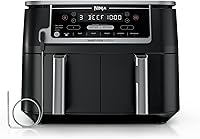
Ninja DZ201 vs DZ550: Which DualZone Is Better? (October 2026)
For Ninja DZ201 vs DZ550, choose the DZ201 for everyday split meals and less counter depth. Choose the DZ550 for larger portions or its built-in smart thermometer.
On this page (10 sections)
- Ninja DZ201 vs DZ550: what actually changes?
- How much basket space will you really use?
- Who should buy the DZ201, and who should skip it?
- Who should buy the DZ550, and who should skip it?
- Will either model fit your counter?
- How should you use Smart Finish and Match Cook?
- How can you get better results from either model?
- What cleanup should you expect?
- When should you choose a different air fryer layout?
- Ninja DZ201 vs DZ550: which should you pick?
For Ninja DZ201 vs DZ550, choose the DZ201 when your usual meals fit smaller baskets and counter depth is tight. Choose the DZ550 when you need larger portions or want its built-in thermometer to monitor proteins.
The deciding question is how you divide dinner between the baskets. A main and side need enough room in their own zones, so total capacity alone won't tell you which model fits your meals.
For context on the rest of the range, our guide to Ninja air fryer models explains where these two fit.


Ninja DZ201 vs DZ550: what actually changes?
The DZ550 adds basket space and a smart thermometer; the DZ201 has a shallower body. Their shared cooking functions mean you should choose around portions, counter fit, and protein cooking rather than the number of programs.
The DZ201 has 8 qt of capacity split between two 4 qt baskets. The DZ550 has 10 qt split between two 5 qt baskets, giving you 1 extra qt in each zone.
That split matters more than the combined number. Neither model turns into one large, open basket when you want to cook a wide item.
Both offer Air Fry, Air Broil, Roast, Bake, Reheat, and Dehydrate, with a stated temperature range of 105°F to 450°F. There's no extra cooking program on the DZ550 that makes it the automatic choice for every kitchen.
Both are rated at 1690 watts, so the DZ550's larger capacity doesn't come with a higher rated wattage. Avoid choosing by power alone or assuming the larger model will finish every meal sooner.
Ninja DZ201 vs DZ550: compare your usual dinner
Picture a complete meal in two separate baskets before choosing. The main may fit easily while the side runs out of room, especially when several people want generous portions of fries or vegetables.
Think about your largest routine dinner, rather than a party you host once a year. Include leftovers if you usually cook tomorrow's lunch at the same time.
How much basket space will you really use?
Choose the DZ201 for moderate portions and the DZ550 when crowded baskets or repeated batches would be a regular problem. Household size helps, but appetite and the type of food matter just as much.
A couple cooking a main and a small side may have different needs from a couple preparing several lunches. A family serving food alongside rice, salad, or another dish may need less fryer space than one cooking the whole dinner in it.
For crisp results, air needs room to move around the food. A basket filled to its physical limit isn't the same as a basket loaded for even browning.
Fries, wings, and vegetables can need shaking or turning, and dense piles make that harder. More space is useful when it lets you spread food out instead of simply packing in another layer.
Ninja describes the DZ201 as holding up to 4 lb of fries or wings and the DZ550 as holding up to 8 lb of wings. These are food-specific capacity claims, so don't treat them as proof that every meal fits twice as much.
Use our air fryer size guide to think through portions. Pay particular attention to the food that needs the most room in a single basket.
Who should buy the DZ201, and who should skip it?
Buy the DZ201 for everyday meals with two different foods when you don't need larger portions or an integrated thermometer. It makes sense for cooks who want separate settings for a main and side without moving up in capacity.
It also suits a routine built around vegetables, frozen snacks, reheating, and proteins checked with a separate food thermometer. You don't need the DZ550's extra feature just to use the shared cooking programs.
The shallower shape can help on a counter where front-to-back space is limited. However, it is wider than the DZ550, so it isn't automatically the better fit for every small kitchen.
Skip the DZ201 if your regular meals already push smaller baskets into crowded layers. Choosing it with the expectation that you'll split dinner into several batches works against the convenience of a two-zone appliance.
Also skip it if built-in protein monitoring is a feature you'll use often. A separate thermometer can check food, but it doesn't give this model the DZ550's integrated Smart Cook system.
Our Ninja DZ201 review looks more closely at the model if its capacity fits your routine.
Who should buy the DZ550, and who should skip it?
Buy the DZ550 for larger portions or frequent protein cooking where its thermometer has a clear role. Its added room is useful when both the main and side need space, rather than only one basket carrying most of the meal.
It also suits cooks who want leftovers without routinely running another batch. Extra capacity earns its place when you use it on normal weekdays.
The included Foodi Smart Thermometer monitors internal temperature. Ninja says the Smart Cook system uses your protein and doneness choices to stop cooking at the selected point.
That helps with temperature monitoring, but you still need to place the probe correctly and follow the manual. Check that the chosen setting meets safe internal-temperature guidance for the food you're preparing.
Skip the DZ550 if you mostly cook small snack portions and rarely prepare proteins. In that routine, its thermometer offers little daily benefit, and the extra basket space may go unused.
Also skip it if your counter can't accommodate its depth and required ventilation space. Our Ninja DZ550 review covers the model separately if those requirements suit your kitchen.
Will either model fit your counter?
Measure depth, width, height, and basket access before buying. The DZ201 is shallower and slightly shorter, while the DZ550 is narrower.
| Model | Depth | Width | Height |
|---|---|---|---|
| DZ201 | 13.86 in | 15.63 in | 12.4 in |
| DZ550 | 17.1 in | 13.9 in | 12.8 in |
Those dimensions describe the appliance, not its full working space. Add the ventilation clearances required by the model's manual and enough room to pull the baskets forward.
Check nearby cabinet doors, the wall behind the unit, and the edge of the counter. A footprint that fits on paper can still leave awkward access during cooking.
Plan a heat-safe landing spot for a removed basket. You should be able to serve, shake, or turn food without balancing a hot basket near the sink or counter edge.
If you plan to store the appliance between meals, consider its weight as well as its dimensions. The DZ201 weighs 17.9 lb and the DZ550 weighs 19.8 lb, which matters if you'll lift either one daily.
Before the first meal, remove packaging, wash the removable cooking parts as directed, and dry them fully. Read the setup instructions before choosing a place for the appliance.
How should you use Smart Finish and Match Cook?
Use Smart Finish for different foods that should be ready together, and Match Cook for foods that need the same settings. Both models include these controls.
Smart Finish suits a main and side with different cooking times or temperatures. It coordinates the finish, but the settings still need to suit each food and portion.
Match Cook copies settings across zones. It's useful when you're dividing one batch between baskets or cooking two foods that genuinely need the same program, temperature, and time.
Don't choose Match Cook just because both baskets contain chicken, for example. Different cuts or thicknesses may need different treatment even when the ingredient is the same.
Before starting, check each zone's settings and confirm which coordinating feature you've selected. It's easy to focus on the food in one basket and overlook the other zone.
The DZ550 also has IQ Boost, which distributes power between baskets when Smart Finish or Match Cook isn't selected. Choose the mode that fits the meal rather than assuming every feature operates together.
When shaking or turning food, keep each basket's contents separate. Returning food to the wrong zone can put it under settings intended for a different dish.
How can you get better results from either model?
Start with manageable loads and settings suited to each food. A two-basket air fryer gives you separate cooking spaces, but it can't make a crowded load behave like a thin layer.
Pat excess surface moisture from foods when appropriate for the recipe. Wet surfaces need to lose that moisture before they can brown, so this step is useful for vegetables and proteins.
Use oil in the amount the recipe needs rather than pouring it into the bottom of a basket. Extra oil doesn't solve overcrowding and adds more residue to clean.
Shake small loose foods or turn larger pieces as directed. Check progress during an unfamiliar recipe instead of assuming a time from another appliance will transfer exactly.
For a main and side, prepare both before you start setting the controls. Cutting vegetables while the main is already cooking can leave you trying to coordinate a meal that wasn't ready to begin together.
Don't assume the smart thermometer checks every piece in a mixed batch. Different sizes can cook at different rates, so follow the probe instructions and check other pieces when needed.
If you use parchment or another liner, follow the appliance and liner instructions. Our guide to air fryer liners explains how liners affect airflow and when they're useful.
What cleanup should you expect?
Expect to clean two baskets and their crisper plates after a full meal. The separate zones keep foods apart during cooking, but they also create more removable parts to wash.
The DZ201's baskets can be washed by hand or in the dishwasher, and both models have dishwasher-safe crisper plates. Follow the DZ550 manual for its baskets and thermometer rather than assuming every removable part is dishwasher safe.
Let hot parts cool before washing. Use a soft sponge and suitable dish soap, and avoid metal tools or harsh abrasives on nonstick surfaces.
Remove trapped crumbs and grease around the crisper plates instead of only wiping the visible basket surface. Residue left behind can affect the next meal and make later cleanup harder.
Dry the parts before putting them back. Keep the main unit out of water and follow the manual for cleaning accessible interior surfaces.
Ninja describes the DZ550's nonstick cooking surface as PFAS-free. That doesn't change the need for gentle cleaning or make every part suitable for the same washing method.
For care details that apply across the category, see whether air fryer baskets are dishwasher safe.
When should you choose a different air fryer layout?
Choose a different layout if your food doesn't suit two separate baskets. Neither of these models is the right answer solely because its combined capacity sounds large enough.
A wide item needs enough space within one basket. Two zones won't help if the food you cook most often needs one broad cooking surface.
A single basket may also suit you better if you usually cook one food at a time. Separate zones are most useful when you regularly need different settings or want to divide a batch.
Consider your serving routine, too. Two zones can coordinate a main and side, but a dinner with several separate hot dishes may still need the oven or stove.
If neither Ninja matches your portions or counter space, compare the best dual-basket air fryers. For a broader choice of layouts, our guide to how to choose an air fryer starts with the meals you cook.
Ninja DZ201 vs DZ550: which should you pick?
Pick the DZ201 when its individual baskets fit your regular dinner and its shallower shape works better on your counter. Choose the DZ550 when larger portions or frequent thermometer use give its extra space and features a daily purpose.
Before ordering, name the meal that would make you regret choosing too small. If that meal is a weekly staple, favor more room; if it's an occasional gathering, consider whether your oven already handles it.
Then check the counter and basket access one last time. Our dual-basket air fryer guide can help confirm that two separate cooking zones suit the way you prepare dinner.
Frequently asked questions
What is the main difference between the Ninja DZ201 and DZ550?
The DZ550 adds larger baskets and an included Foodi Smart Thermometer. It has 10 qt of total capacity, compared with the DZ201's 8 qt, but both divide that space between two independent zones.
The DZ201 is shallower, while the DZ550 is narrower and slightly taller.
Do the Ninja DZ201 and DZ550 have the same cooking functions?
Yes, both offer Air Fry, Air Broil, Roast, Bake, Reheat, and Dehydrate. Both also include Smart Finish and Match Cook for coordinating their two zones.
The DZ550's thermometer adds internal-temperature monitoring for proteins, rather than another cooking program, so choose around meal size and how often you'll use that feature.
Can the Ninja DZ201 cook two foods at once?
Yes, the DZ201 has two independent cooking zones, so you can prepare a main and side with different settings. Smart Finish coordinates their end times, while Match Cook copies settings between baskets.
Keep foods with very different cooking needs in separate zones and check each food before serving.
Is the Ninja DZ550 worth choosing over the DZ201?
Choose the DZ550 when your regular meals need more basket space or you want its included thermometer for proteins. Its extra capacity is less useful if your portions already fit the DZ201.
Check counter depth first, since the DZ550 needs more space from front to back.
How should I choose between the DZ201 and DZ550 for my household?
Choose around your busiest normal dinner, including both the main and side. Consider how much space each food needs, whether you want leftovers, and how often you cook proteins.
Our air fryer size guide helps you match capacity to portions before you measure your counter.